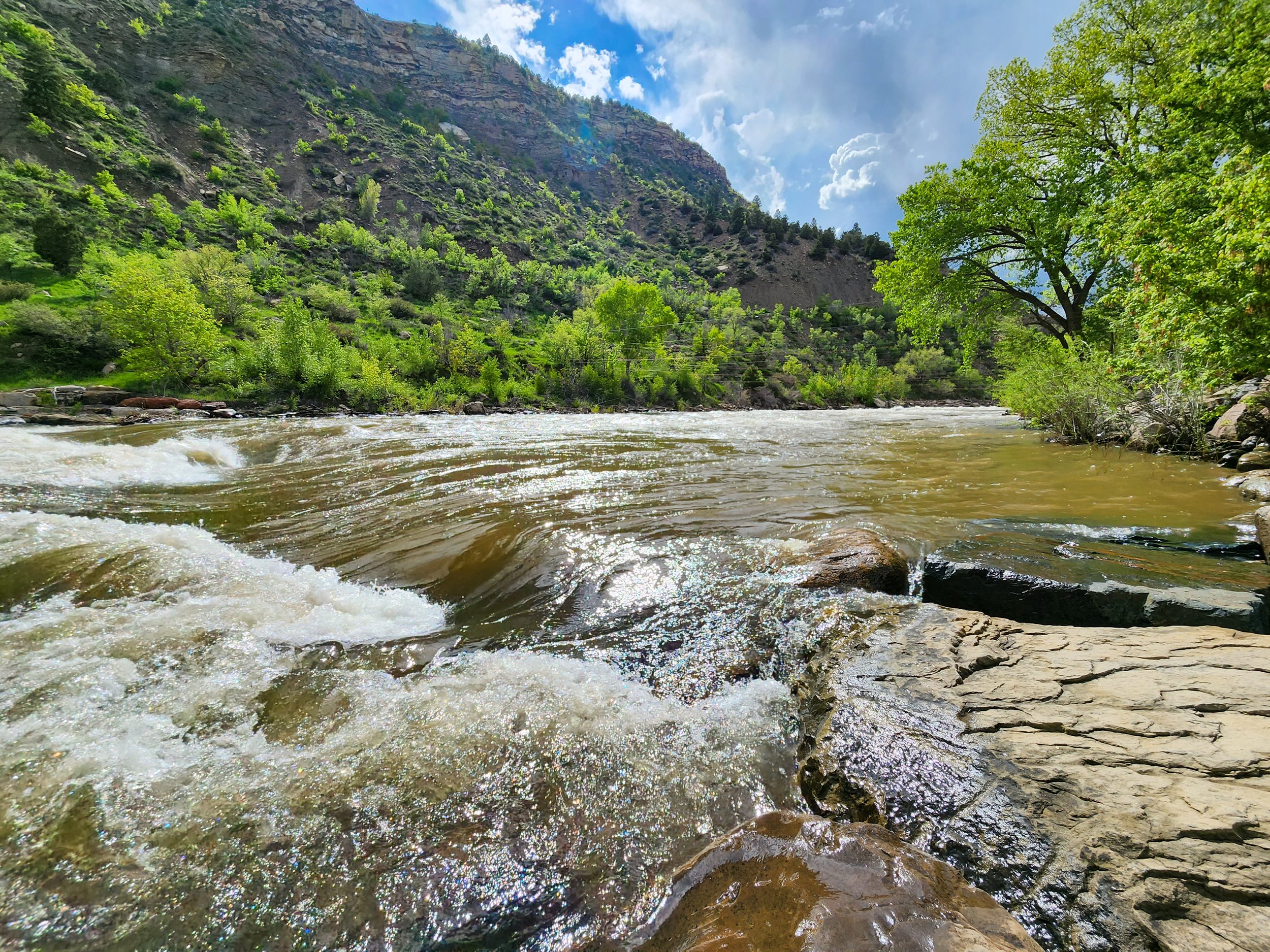

Seattle and the Puget Sound lowlands have no shortage of stunning mountain and coastline vistas. But if you look closely, there is an equally impressive story being told right beneath your feet, one that makes the region unlike almost anywhere else—and that has tremendous implications for the practice of environmental consulting.

Matthew von der Ahe, Geologist, explains the history and appearance of the Blakely Formation in West Seattle.
“‘It’s more complicated than that’ - I’ll probably end up saying that a lot today.” It’s a brilliant sunny Friday in late May and Matthew von der Ahe, a geologist in Aspect’s Bellingham office and former college geology instructor, has just guided his latest “class” of colleagues to their first stop on a day-long geology field trip. Matthew has been offering these field trips for the last decade to educate colleagues across the firm about the fascinating and often quite complicated geological world we work and live in.
Observing layers of glaciation at Discovery Park.
The day begins with a hike out onto a West Seattle beach, a rare spot where the 35-million-year-old Blakely Formation is visible at the surface. Here, and at other stops around town, the group observes evidence of the fascinating forces that have shaped the Puget Sound lowlands, a unique combination of glaciation and fault activity. Along the way, they see firsthand evidence of the different layers of glacial sedimentation, and gain a better understanding of the context for much of their work, from construction to remediation. One stop in Magnolia, where landslide activity swept three homes into Puget Sound and left another sitting condemned, plainly illustrates how important it is to understand the forces at work at each site.
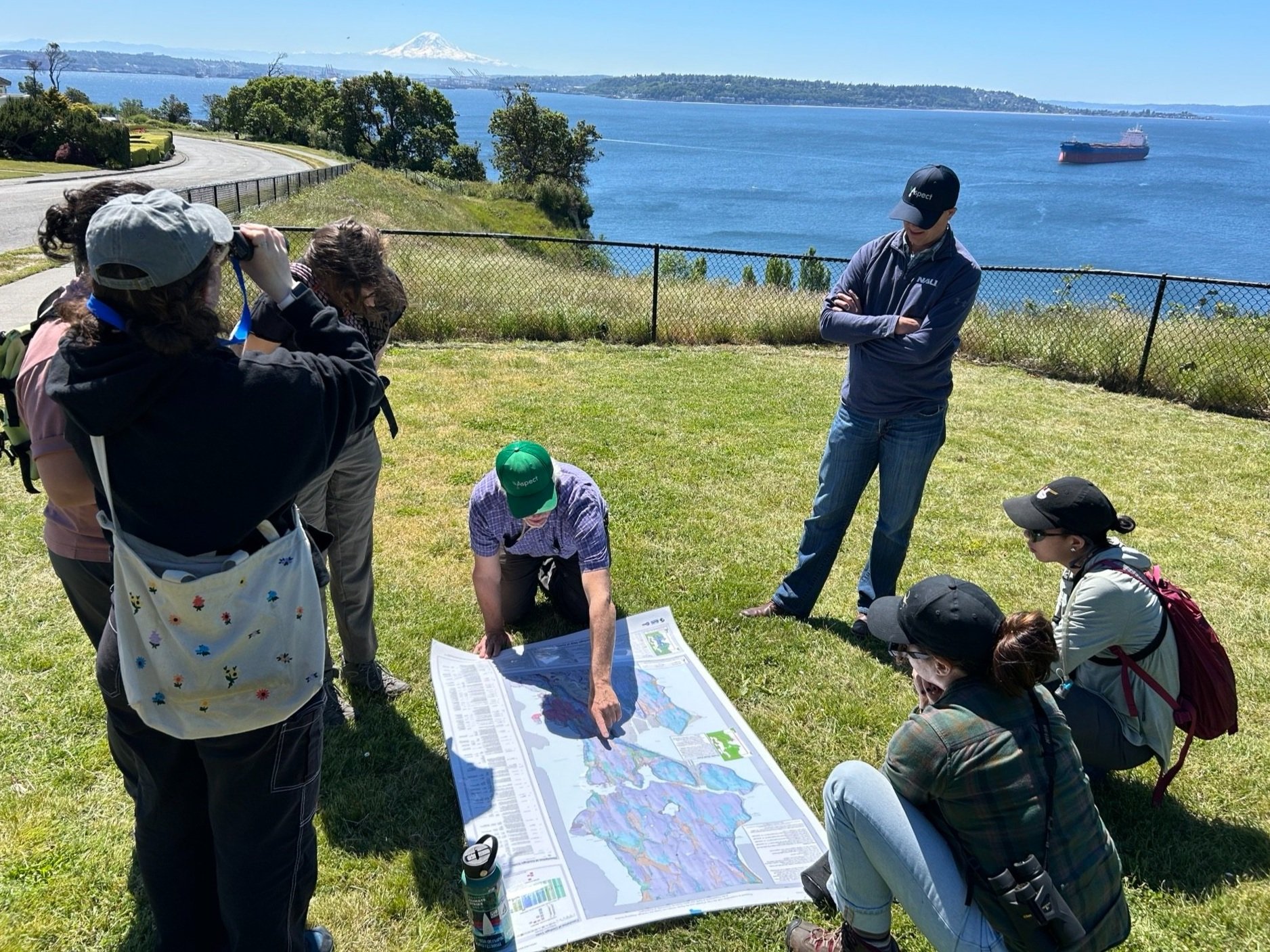
Seeing the map come to life.
The dynamic nature of this region offers exciting opportunities for geotechnical, environmental, and water resources work, and while there are numerous resources available through a consultant’s laptop, there’s nothing quite like getting out in the field to see how the different facets of this fascinating landscape are connected. “It’s so valuable to see these things you’ve been thinking about,” says Senior Principal Geologist Dave Cook. “You could never see it enough, whether you’re in your third year or your thirtieth.” Maya Morales-McDevitt, a professional at Gradient, echoed that sentiment: “Experiencing this reminds me of all the possibilities in consulting.”

The day ends on the south slope of Queen Anne, taking in a view of Seattle’s rapidly growing built environment, with Mount Rainier sparkling in the distance. After a day spent in the field, the landscape makes sense in new ways. Everything feels connected. “I keep waiting for someone to say, ‘I can’t believe we’re paying you to do this,” Matthew says, “but instead, they keep saying, ‘I wish you’d do this more.’” You can tell from Matthew’s enthusiasm that he hopes this is the case.

Viewing the elusive Lawton Clay on the beach at Discovery Park.